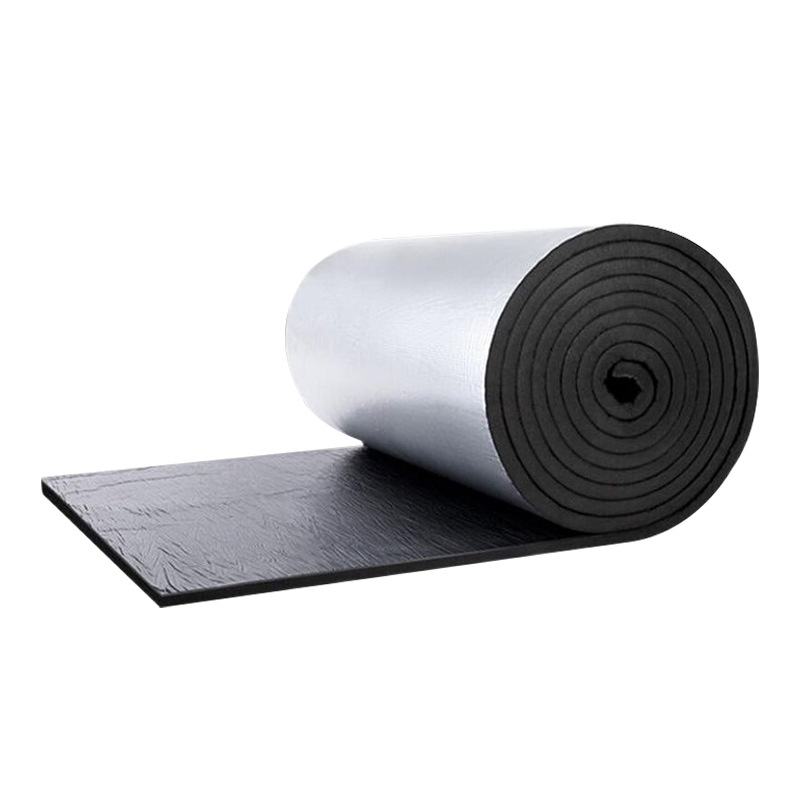
Complete Parameters of Aluminum Foil Clad Elastomeric Foam Insulation Board
National Standard: GB/T 17794-2021 Flexible Foam Rubber and Plastic Thermal Insulation Products
1. Structure Composition
Core material: Closed-cell foamed blend of NBR (Nitrile Butadiene Rubber) and PVC (Polyvinyl Chloride), black microporous structure with closed cell rate ≥98%
Surface layer: Aluminum foil (plain bright aluminum foil, grid embossed aluminum foil, reinforced mesh aluminum foil, PET composite aluminum foil); foil thickness 8~20μm, thermal radiation reflectivity ≥85%
Optional: Pressure-sensitive adhesive layer on the back (self-adhesive aluminum foil clad elastomeric foam board)
2. Standard Dimensions
Thickness (standard sizes & customizable):
5mm, 6mm, 8mm, 10mm, 15mm, 20mm, 25mm, 30mm, 40mm, 50mm
Width
Standard: 1000mm (1m); widened sizes: 1200mm, 1500mm
Length
Standard rolls: 8m, 10m, 20m, 30m; custom-cut flat sheets available
Forms
Rolls, cut flat sheets, aluminum foil clad elastomeric foam pipe shells for pipelines
3. Core Thermal Performance (Qualified Product Standards)
表格
| Parameter Item | Standard Index | Unit | Remarks |
|---|
| Thermal Conductivity (0℃) | ≤0.034 | W/(m·K) | Premium products: approx. 0.032~0.033 |
| Operating Temperature Range | -40 ~ +110 | ℃ | Max temperature of self-adhesive type: approx. 85℃ |
| Water Vapor Diffusion Resistance Factor μ | 8000~20000 | — | Aluminum foil greatly enhances vapor barrier capacity with excellent anti-condensation performance |
| Volumetric Water Absorption | ≤4 | % | Waterproof closed-cell structure |
| Thermal Reflectivity (Aluminum Foil Surface) | ≥85 | % | Blocks radiant heat, ideal for roof thermal insulation |
4. Physical & Mechanical Performance
Apparent density: 45~95 kg/m³ (national standard upper limit ≤95 kg/m³)
Tensile strength: ≥0.5 MPa
Elongation at break: ≥150%
Low-temperature bending test (-20℃): No cracks
Compression resilience: ≥90% after 50% compression
5. Combustion Performance (GB 8624)
Grade B1 (Hardly Flammable, widely used for central air conditioning and fire protection projects)
Limiting oxygen index ≥32%
Smoke density rating (SDR) ≤75
Self-extinguishes after flame removal, no molten drips
Grade B2 (Flammable, for ordinary residential buildings and color steel tile insulation)
Limiting oxygen index ≥26%
Note: Aluminum foil is Class A non-combustible facing, which only improves surface flame retardancy and cannot change the inherent combustion grade of the elastomeric foam core.
6. Acoustic Performance
Noise Reduction Coefficient (NRC): 0.45~0.65; integrates thermal insulation, sound absorption and vibration damping, ideal for air duct noise reduction
7. Classification & Differences of Aluminum Foil Types
Plain bright aluminum foil: Cost-effective, moisture-proof and reflective, prone to slight oxidation
Grid embossed aluminum foil: Tear-resistant, anti-bulging and anti-aging, mainstream choice for engineering projects
Reinforced mesh aluminum foil: Ultra-high tensile strength, long-term outdoor weather resistance and anti-tearing
PET laminated aluminum foil: Anti-oxidation, acid & alkali resistant, UV resistant, longer outdoor service life
8. Typical Application Scenarios
Thermal insulation for central air conditioning air ducts, cold insulation for chilled water pipes, thermal insulation for steam pipelines, color steel tile roof insulation, wall sound insulation & thermal insulation, machine room noise reduction, thermal insulation for storage tanks
 ch
ch English